Ericsson: Building the invisible backbone of a connected UK
09 July 2026
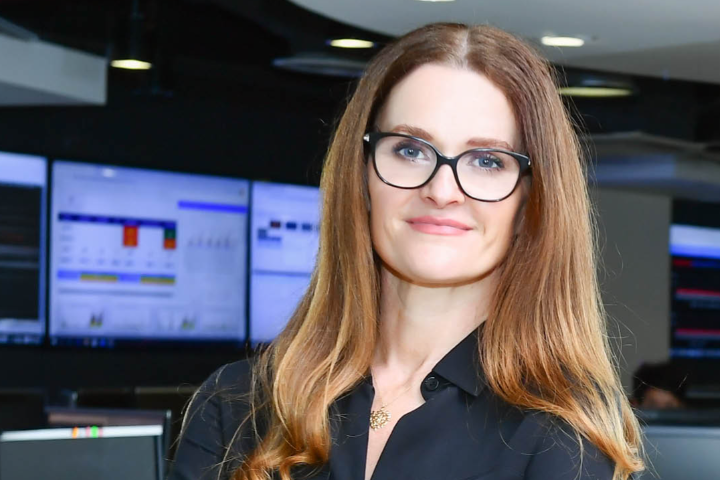
One hundred and fifty years is a rare milestone in any industry. For Ericsson, the anniversary is less a museum moment than a reminder of a long running habit: being present at every major shift in how people communicate. We talked to Nadine Allen, Country Head UK – Ericsson, and newly elected Board Member of the Swedish Chamber of Commerce for the UK about her leadership and what the company’s 150-year anniversary means to her. As Nadine puts it: “What strikes me most is not any single moment but rather the thread of continuity: a company that has consistently found itself at the centre of how people connect”.
From fixed lines to intelligent networks
From fixed telephony to the first mobile networks, and later the leap from 2G to 3G and 4G, Ericsson has helped turn connectivity from a place bound utility into something that follows people, devices, and ideas. Today, Nadine argues, that the most profound transformation is one we’re living through right now. “The convergence of 5G and AI is not just another upgrade cycle, but a fundamental shift in what networks are used for,” she explains.
She elaborates: “We are moving from networks that carry communication to networks that actively sense, predict, and respond in real time. That is a different kind of infrastructure entirely.”
For Nadine, that is what 150 years really signals: not just longevity, but a track record of shaping each new era of connectivity as it arrives.
The UK’s invisible backbone
Nowhere is this history more tangible – and more invisible – than in the UK. Ericsson has been present here for more than 125 years, quietly supplying equipment, expertise, and investment through successive generations of networks.
Nadine likes the idea of describing Ericsson as an invisible backbone as it captures something important about how connectivity works: “When things are working well, people should not have to think about it.”
From a London sales office in 1898 to today’s advanced mobile and 5G networks, Ericsson has underpinned many of the UK’s big steps forward in connectivity. Decades of collaboration mean the company understands the UK market deeply, from regulation to enterprise needs and national technology ambitions – and is trusted to deliver against them.
Always looking to what’s next
Ericsson’s 150-year anniversary tagline ‘Always looking to what’s next’ suggest that companies don’t last this long unless they are always looking forward. If the past 150 years were defined by getting people and information connected, Nadine believes the next phase will be defined by what happens when advanced connectivity and AI collide.
In Ericsson’s strategy, that mindset shows up in a clear position: the next industrial phase of AI will only be as good as the networks that support it. “Best effort connectivity will not be sufficient. What is needed is guaranteed, programmable, intelligent connectivity – and that is exactly what we are building with our customers,” Nadine explains.
The actualities of AI and the network
In practice, Ericsson sees two big shifts. The first is that AI is raising the bar for what networks need to do. New applications – from real time analytics to connected machines – depend on connectivity that is not just fast, but reliable, responsive, and secure at scale. “4G and Wi-Fi simply cannot deliver that consistently. 5G, and in time 6G, are the foundations that make it possible,” Nadine says.
The second shift runs the other way: using AI inside the network itself. “The second direction is how we use AI in networks to make them smarter, more efficient, and increasingly autonomous.” Ericsson is already deploying AI across its portfolio so networks can predict, optimise, and resolve many issues automatically – moving from infrastructure that is managed to infrastructure that can, increasingly, manage itself.
Leadership built on context, trust and optimism
Nadine’s Ericsson story began in the UK, working closely with operators such as EE and MBNL. As Nadine explains: “Coming back as Head of the UK feels like coming home. Though the market, the technology, and my own perspective have all changed considerably since then”.
Out of that journey, a few lessons stand out. The first one is that context shapes everything, and adaptability is very important. She explains: “The same technology and the same strategy can land very differently depending on the market, the relationships, and the moment. Learning to read that, and to adapt without losing your sense of direction, is one of the most important skills a leader can develop.”
The second lesson that Nadine brings back with her is that trust is your foundation and optimism is a duty. Nadine has seen how important genuine personal connection is to build trust, and how “Investing in personal relationships and making room for fun in the day-to-day pays back in ways that are hard to quantify but impossible to ignore. Teams that trust each other and find moments of real connection alongside the work are more resilient, more creative, and more committed”.
A human lens on navigating continuous change
When it comes to leading through transformation, Nadine’s take is that uncertainty is not an exception but the rule: “For me, being future-ready starts with accepting that uncertainty is not a problem to be solved, but a permanent condition to be navigated well. The leaders and organisations that thrive are the ones who make high-quality decisions with incomplete information and adapt as they learn”.
Future readiness, she argues, is ultimately about “building the capability to learn and respond faster than the environment changes”, which is something she sees as applying equally to organisations, networks, and leaders.
Stepping into the SCC UK boardroom
Nadine’s appointment to the board of the Swedish Chamber of Commerce for the UK is, for her, a natural extension of what she cares about most: building connections and conversations that create long-term value. She sees Swedish companies as deeply embedded in the UK economy and believes SCC UK is a place where that shared value can be articulated, and Swedish and UK business leaders can learn from each other. “Being visible and active in the Swedish business community in the UK feels consistent with Ericsson’s commitment to the UK, not just as a market but as a genuine partner,” she says.
The future of connectivity through the Ericsson lens
Despite talk of telecoms as a mature utility, Nadine is convinced the real story is just beginning. “What gives me the most optimism is that we are at the beginning, not the end, of what connectivity can do.”
She sees the UK as uniquely well placed to lead this next phase: a strong operator ecosystem, a world-class research base and a track record of backing ambitious infrastructure, from the Emergency Services Network to cutting edge 6G research.
For Ericsson, the role in that story is already clear. “We carry more than half of global mobile data traffic outside China, we lead in AI for networks, and we are the partner that operators turn to when they are trying to build something genuinely new. That is a privilege and a responsibility.”
Looking ahead, Nadine brings it back to impact. “Twenty years from now, I want to look back and feel that we helped the UK, and the world, realise the full potential of what intelligent connectivity can do.”