When does future-proofing stop helping?
16 April 2026
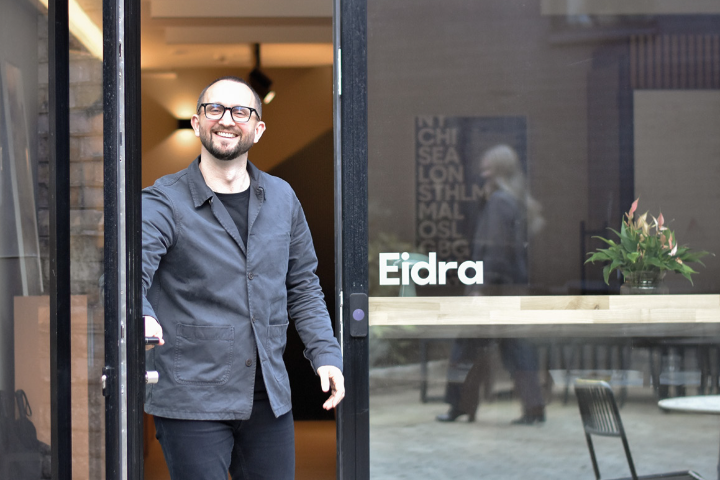
We’ve all heard it. Future-proofing. It sounds reassuring and hard to argue with. But Paul Harrop doesn’t deal in comfortable consensus. As UK Managing Director of Eidra – a 1,400-person global consultancy headquartered in Sweden – he’s spent years sitting with organisations at the point where plans meet reality. And that vantage point tends to produce some inconvenient questions.
His background is in product, sharpened by experience in strategy and technology consulting, and filtered through a lens of economics and behavioural economics that often challenges conventional wisdom. So, when the subject of future-proofing comes up – SCC UK’s theme of the year and a phrase currently doing a lot of heavy lifting across boardrooms – his reaction is telling.
“Mild frustration,” he says, smiling. And then he explains why.
The problem with the word ‘proofed’
“The future is unknown. Proofing assumes you’re fixed. So how can you ever be future-proofed?”
Paul encourages us to sit with that thought for a moment. The word proofed implies completion – like sealing a document, or waterproofing a jacket. You do the thing, and then you’re done. Safe. Sorted. Ready for whatever comes next. Except, as Paul points out with certain humour, nothing complex works like that.
“If I built a castle back in the day, was I future-proofed? No – because the weaponry changed.”
Paul explains how every time an organisation entrenches itself around a fixed model of the world, the world subtly reorganises itself around that decision. It’s not that future-proofing is a bad instinct – the desire to be prepared is entirely rational. The problem, according to Paul, is the static solution mindset it tends to produce at precisely the moment organisations need to be dynamic.
“The language locks you into a static solution mindset at exactly the moment you need a dynamic capability mindset.”
There’s a literary dimension to this, too. Paul cites an unlikely source – Gould’s Book of Fish by Richard Flanagan, an Australian novel – to land the point. In it, there’s a line he returns to often: “Definitions belong to the definer, not the defined.” With this, Paul points out that just because you’ve decided something is future-proofed doesn’t make it so. The market, as ever, has its own ideas.
What to aim for instead – and what it actually takes
So if ‘future-proofed’ is the wrong destination, what’s the right one? Paul’s answer is less a slogan and more a philosophy: future preparedness. Resilience, yes – but not the passive kind.
“You’re going to get knocked around, you don’t know what’ll happen, but you need to be able to get back up. And I think also front foot. You need resilience to get back up in a fight, but you also need to be able to attack.”
He talks about organisations needing to shrink the gap between “something has changed” and “we’ve adapted to it.” That requires three things working together according to Paul: sensing change earlier than your competitors, interpreting what that change means for your specific context, and moving fast enough to act before the window closes. Most organisations, he observes, are genuinely good at one of the three. Very few are good at all of them. And critically, the sensing, the interpreting, and the acting tend to happen in different parts of the business – disconnected from each other, the signal diluted by the time it reaches anyone who can do something useful with it.
“Joining those three things up is usually where the real work is.”
AI, amplification, and the risk of efficient drift
It wouldn’t be a business conversation in 2026 without a discussion of artificial intelligence – but here too, Paul resists the familiar narratives. He’s neither breathlessly optimistic nor performatively sceptical. What he offers instead is a useful reframe.
“AI is a signal amplifier, not a signal interpreter.”
Where it genuinely helps, he argues, is in processing the sheer volume and velocity of information that humans simply can’t. Spotting patterns at speed, reducing friction in synthesis, freeing up leaders to spend more time actually deciding rather than assembling information. All real. All valuable.
Where the hype outpaces the help, in his view, is anything that tries to replace human judgement at the interpretation layer. AI can surface that something is changing. It cannot yet tell you what that means for your organisation – your culture, your positioning, your relationships, the things that are not in any dataset.
“Speed without direction is just a faster way to get lost. The strategic and cultural layer has to stay human, or you end up with very efficient drift.”
There’s a specific trap he flags for leaders who are currently excited about cost reduction through automation: the bottleneck doesn’t disappear, it moves. “We’ve been through these cycles many times where leaders see productivity gains, forecast cost reduction, and then reduce their headcount. And then the people that could have wrangled that – they need to recruit back in.” He calls it a Jevons paradox: new technology creates new use cases that people need to do things for. It’s always been the case, and there’s no particular reason to think this time will be different.
The human factors that actually matter
Strip away the frameworks and the technology, and Paul keeps returning to two things: psychological safety and decision rights.
He is direct about the risks here. In his view, if people don’t feel safe raising bad news early, the early warning system fails at source. He sees how leaders can end up making decisions based on a sanitised version of reality and then wonder why the strategies keep missing. For him, unclear decision rights are just as risky – if adapting to a new signal means escalating through multiple layers before anyone feels able to act, the moment has effectively passed.
And then there’s what he calls “tolerance for being temporarily wrong.” Organisations that treat a wrong bet as a failure learn slowly and painfully. Organisations that treat it as data learn fast and cheaply. “That’s not a process – it’s a cultural norm, and it comes almost entirely from how leadership behaves when things don’t go to plan.”
He has a phrase for the kind of leadership he thinks organisations will need more of: the generalist synthesiser. Not the deep specialist, not the empire builder, but the person who can hold complexity without collapsing it too early. Who can sit with ambiguity, work across domains, and make sense of signals from multiple directions. His practical suggestion is simple: start a weekly 30-minute habit of reading one thing outside your industry to notice what questions it raises about your own context.
From concrete to conference stages – a partnership in practice
To see what this thinking looks like when applied, consider one of Eidra’s recent client partnerships. A ConstructionTech company came to Eidra with a focused hardware brief: reduce unit costs significantly. Paul and his team spent days on construction sites, learning the domain from the ground up. The team achieved and exceeded the target hardware cost reduction – but that turned out to be just the start.
“Just because you have figured out a way to lower unit cost on hardware doesn’t mean the business thrives. That hardware then needs to connect with the cloud. And if that cloud is underperforming, then you’ve got to solve that.”
What followed was a full business transformation – SaaS design, brand strategy, visual design, spatial design, and more. One brief resolved bottleneck by bottleneck. That, Paul would say, is sense-and-respond in action.
The direction of travel
For Paul, strategy has become less about a fixed plan and more about a maintained direction with flexible execution. That’s a harder thing to communicate to an organisation, and a harder thing to hold onto when markets are volatile and investors want certainty. He’s honest about that tension.
The organisations that navigate that tension best, he suggests, are the ones that have stopped looking for the fortress and started building the fitness. That can compete in races they didn’t even know were coming.
Future-proofing as a label? Potentially useful – it can rally people, force them to think about scenarios, create shared language inside large organisations where alignment is genuinely hard. As a destination? In Paul’s view, it does not exist. The future will always have moved.
What remains is the day to day work of adapting – steady evolution, sudden disruption, and a willingness to accept that the job is never quite finished.
5 quick questions with Paul
Extra free day in London?
Browse, eat and drink on Bermondsey Street, wander through Maltby Street Market, grab a coffee at Monmouth and then go to the marvellous Brotherhood Games shops in Bermondsey Blue to geek out on games, cards, and merch. And if you’ve still got the energy, head to the Brunel Museum and Mayflower pub for some added culture and a well earned drink on the river.
One small daily habit?
Codifying what I know or what I’ve learned about a thing that day. And then collating that in a repository. At this point in my career, it’s a sprawling, chaotic list of quotes, visuals, frameworks, etc. But it’s a wonderful reference point for me, that I use often.
Last thing that really stuck with you?
In Athens recently, I took a jewellery making course with my family and a friend. I wasn’t expecting much from it, but truly loved it. It was the combination of imagining something physical, experimenting with how to create it, playing with tooling and techniques, failing, starting again. And ultimately creating something flawed, but distinctly mine. Loved it!
If Eidra was a person?
Obi-Wan Kenobi. And I mean that seriously, not just as a Star Wars fan. Think about what makes him distinctive – he’s not the most powerful person in the room, he’s the wisest. He doesn’t impose a solution, he helps others find their own clarity. He’s steady when everything around him is moving fast. And he’s always thinking about the long game, not just the immediate battle. That’s genuinely what I want Eidra to be. An organisation that makes the people it works with more capable, not more dependent. That earns trust slowly and keeps it.
That brings calm and rigour to moments that feel chaotic. If a client walked away from us thinking ‘I can handle this now’ – that’s the win.
One sentence of career advice to your younger self?
“Map it. Model it. Draw it”
I’m a visual thinker. If I can’t visualise it, I don’t understand it. So, embrace that.
About Eidra
Eidra is a Nordic-born consultancy collective, founded in Stockholm in 2019. It is built on the conviction that real business transformation requires deep collaboration between consulting, creativity and engineering. The collective brings together over 1,400 specialists across 17 offices in Europe and the US under a partner-owned model. Eidra’s London office connects that Nordic heritage – pragmatic, design-literate, engineering-led – with the scale and ambition of the UK market.