A Day's March and the Pink Elephant in the room
05 November 2026
The morning meeting. The client lunch. The gallery thing someone at work insisted on, and the dinner that ran longer than expected. A lot of people move through a day like that with a quiet, nagging question about whether what they’re wearing is right for the next thing on the list. Johannes Hobohm believes that’s a problem worth solving, and as CEO of the Swedish brand A Day’s March, he already has.
“It doesn’t really matter where you’re going,” he says. “If you go to a lecture, then end up meeting your parents-in-law for the first time and then head to a nightclub – you will not break any dress code, and you will not be wrong in our clothes.” That promise is quite literally at the heart of the company – it is in the name. A Day’s March: an old military term for the distance a soldier could cover in a single day. To Johannes, it’s just as topical now as when the brand launched back in 2014 and he first fell in love with it.
Joining the call for our interview, all the conference rooms are taken. Johannes is sitting in what he calls ‘the scrub’ – a cupboard, essentially – for a brand built on being at ease wherever you land, it’s kind of an ideal way to start.
Johannes’s journey with A Day’s March started out as a big fan of the brand. Then investor, alongside his brother and cousins. Then board member for six years. Then, when the previous CEO left, he was asked if he’d take it on as an interim. “I was already a huge admirer of the brand, but this is where I also fell in love with the project. I believe that there’s a place for us in people’s wardrobe.”
Smart enough, relaxed enough
Something is happening in the setting of professional dressing that A Day’s March has positioned itself to meet. “A lot of companies are slowly moving from the obligation of wearing a tie to being still very well dressed but relaxed,” says Johannes. “And that’s where we fit right in.” And he is onto something. The tie has gone, and the suit has retreated, at least a little bit. The replacement found in smart casual, business casual – whatever you want to call it – has created its own kind of question-marks, because the rules aren’t as clear and no one wants to get it wrong.
The target customer does not necessarily care deeply about fashion. It is someone who “would rather talk about tennis or football or a good pint,” and just needs to get dressed in the morning without thinking about it too hard. “We help people, generally men, who are not particularly interested in clothes. We help them solve their clothing problem.”
The result is that kind of non-negotiable loyalty that retailers dream about.
What independence actually buys you
“We are independently owned. We are not part of any big group. That makes us very agile and flexible.” That independence matters in ways that go beyond the marketing. It means the brand can collaborate with an 88-year-old Swedish artist whose retro, naïve paintings from the 70s and 80s feel at once nostalgic and completely fresh. It means commissioning overshirts in Harris Tweed – hand-woven in Scotland, without electricity, on looms that cycle the fabric by foot – launching this October. It means owning the pink elephant from a beloved Swedish children’s television programme and putting it on a postcard tucked into every online order, because why not.
A townhouse, a rail of clothes, and the M&A department
The community model A Day’s March has developed in Sweden is next on the UK agenda. Rather than waiting for the right customers to find them, they go looking. Sometimes that means inviting an entire department from a bank in for an after-work event – drinks, curated selection, good music, personal service. Sometimes it means rolling a rail of clothes into a company lobby and taking orders on the spot.
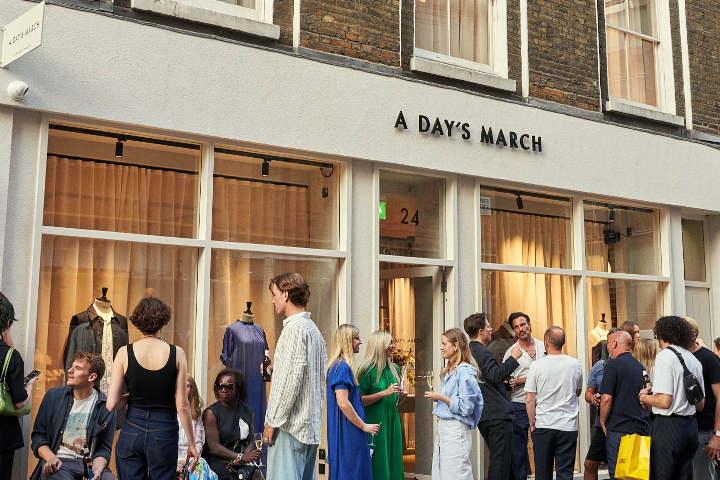
In London, the base for all of this is a three-storey townhouse in Soho. The third floor has a bar. “We want to use our amazing townhouse as a second home for companies,” Johannes says. “A place where you can have cocktails and after-works with either the staff at the companies or even with their clients.
We just want to spread the word that we’re here.” The flexibility extends further: Christmas gifts for an entire staff, bespoke orders, whatever serves the relationship, you name it. “Again, we’re independent, so we’re quite flexible.”
Soul over strategy
Before the last World Cup, A Day’s March hosted an evening in Sweden with two former national football team players and a pundit. Nobody was there to be sold anything. Johannes is direct about that: “We didn’t really try to sell anything. It was just like, you’re a friend of us. Please come.” A clothing brand, hosting a football night, moving no product. To him, that is not a missed opportunity. It is the whole point.
What he is describing is the difference between a brand image and a brand world. The first is what a company looks like. The second is what it feels like to be inside it – what it cares about when nobody is buying, whose company it keeps, what it finds funny. “What our brand world entails is partly football, or music, or films, or whatever it is. Then you find the people who like that too, and who like how you talk about it – and so they like you.”
The pink elephant is another version of the same instinct. A character from a beloved Swedish children’s television programme, still on public archive television, still what Swedish parents use to teach their kids to read, that the brand liked so much they eventually bought the rights to it outright. It appears on clothes, on postcards tucked into online orders, in the window of the Soho store. Tourists pick it up as a souvenir without knowing its history. Swedes in their late thirties recognise it immediately and feel something.
All of this matters most, he points out, precisely because the core product is a white t-shirt. “That’s quite important when you’re mostly selling white t-shirts, because how will our white t-shirts going to differ?” Differentiation at the product level has a ceiling. Differentiation at the level of soul does not. “We try to be warm and playful. We don’t take ourselves that seriously. Which I like.”
Don’t go across the river to get water
When asked what success looks like in twelve months, Johannes emphasises the Swedish community here in London. “We don’t have to go across the river to get water,” he says. “Can we just be popular among Swedes? There are so many Swedes in London. That’s enough.” Then everything, he thinks, takes care of itself.
When Johannes came in as CEO two and a half years ago, he had come from film and television, where the opening weekend is everything and you have roughly 48 hours to make people understand what you are. That sense of a compressed first impression has shaped the way he steered the business. “You have to decide what hill you’re going to die on and then just fight with that.”
Knowing exactly who you are for, and resisting the pull to be for everyone, is one of the harder things any organisation can do. A Day’s March had to close stores, cut categories, and disappoint a few people to get there. But the clarity it creates is visible.
That kind of focus has a ripple effect, the people who find you tell the people they know, and suddenly you don’t need to shout. “I think the ripple effect would be like they talk to their friends and family,” he says. It is, for what it’s worth, not a bad description of how any good professional community works. Including this one.