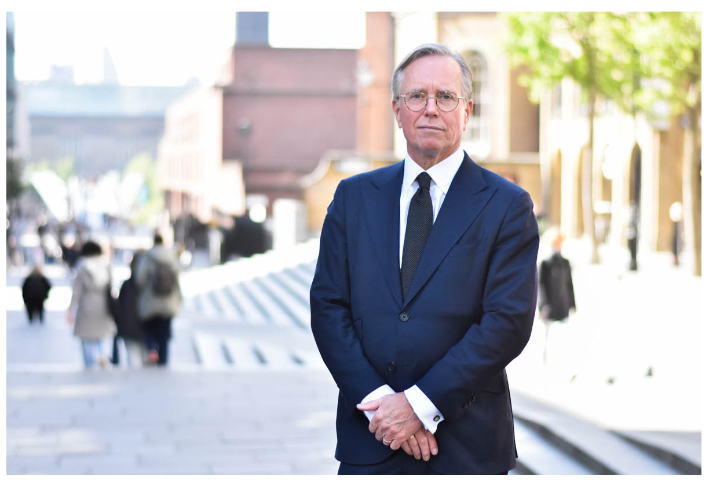
Meet Mats Torstendahl – SCC UK's new Chair
11 June 2026
In a year when uncertainty has become the norm and technology is rewiring whole sectors, SCC UK is welcoming a new Chair who has spent his career leading through change. With nearly four decades in banking and 18 years at SEB, Mats Torstendahl brings both a long view and a steady hand. He joins the Chamber to build on what already works – and to help the Swedish-British business community navigate whatever comes next.
Nearly 40 years in the making
Mats did not plan a career in banking. After graduating from The Royal Institute of Technology in Stockholm, he was destined to start working with one of the big engineering companies. It happened to be ABB, or Asea, as it used to be called.
After a few years in ABB he was recruited to banking, which was, in all aspects, uncharted territory for him.
Firstly, he spent some 20 years with what later became Danske Bank in Sweden, ending up by being responsible for their activities in Sweden.
In April 2008 he signed his contract with SEB and has spent the last 18 years in the Bank in different positions. He now has the privilege, as he describes it, to be the Country Head of SEB UK.
“When I started in banking, I was going to give it two years,” he admits. “And then almost 40 years later I’m still in banking – you can draw two potential conclusions from that: Maybe I am simply not employable anywhere else,” he says with a humble smile. The conclusion Mats is rather more inclined to draw, though, is that "I’ve had a fantastic journey in everything I’ve done, and I do not regret a moment of it.”
Turning a heritage bank towards entrepreneurs
Mats' most significant chapter at SEB came when he was asked to lead what was then called the Retail Division – a role he held for 12 years, during which time the Division was renamed more than once, eventually becoming Business and Retail Banking. His ambition was clear from the start: to take a bank historically built around large corporates and turn it into a genuine home for entrepreneurs and SMEs.
To make the case internally, he reached back into SEB's own story. When the Wallenberg family founded what was then called Stockholm's Enskilda Bank in 1856, the original purpose was to support the industrialisation of Sweden – giving growing companies access to liquidity, working capital, and capital markets. "That was kind of the driving force for SEB to start to follow these companies internationally," Mats explains.
That founding spirit, he argued, was not so far from the entrepreneurial energy he wanted to nurture. "It was very easy to commit to the belief that we needed to be the bank for entrepreneurs." And Sweden, he notes, had by then undergone a genuine cultural transformation. When he graduated from the Royal Institute of Technology in 1985, starting a company would have seemed suspicious to many. By the time he was making the case for entrepreneurs at SEB, a generation of Spotify-scale businesses had changed the picture entirely.
"This is a transformation – a real change of mindset across society – and politics is part of that, business is part of that, and education is part of that. It is something we should genuinely be proud of," says Mats.
The shift worked. Mats describes the 12-year journey as “a very inspiring change and transformational programme” – one that moved SEB from an almost entirely analogue distribution model to a far more digital operation. “We had not finished when I left – and it is all still work in progress,” he says, with the honesty of someone who knows that transformation never really finishes.
London calling
After his time running Business and Retail Banking, Mats became Deputy CEO – a role combining structured responsibility with a fair amount of the unpredictable. Then came London. “I was asked if I wanted to become responsible for our activities in the UK and, after a short discussion with my wife – I think five minutes – the decision was made.”
“I have been here many times, but I have never lived here and having the opportunity to do that was of course an offer you can’t refuse,” he says. He pauses. “I feel very privileged that I am here right now.”
SEB's presence in the UK is long-established – the bank has been here since the 1960s – and the ties between SEB and SCC UK run even deeper. "We are a part of the Wallenberg sphere, and we are very proud of that," Mats says. The Wallenberg family founded SEB in 1856 and were founding members of the Chamber in 1906, and for Mats, the connection is not merely historical. It speaks to the shared belief that Sweden, as a small country with global ambitions, has always needed to look outward. "There are long-standing relationships between Sweden and the UK." Culture, language, and a shared instinct for trade have made Britain a natural home for Swedish business.
What he sees from clients – and what keeps him up at night
Mats is candid about the world and the fact that businesses are currently navigating in uncharted waters. His clients are managing complexity on several fronts at once, and he feels the risks have been building for years – through a period when, as he puts it, many had “become a bit complacent” and “didn’t really understand how the risks were mounting up.”
And yet, when he talks about technology – and AI in particular – his focus shifts from risk to possibility. “Investment into AI is totally amazing, especially in the US,” he notes, and he believes the momentum there is reshaping what will be possible for businesses everywhere. And the speed of change being fuelled by AI has never been seen before.
Looking back to the early internet era, he draws a deliberate parallel: “If you go back to around the millennium and the internet boom, what we saw was that productivity increased quite dramatically. I think this will be the same.” Some roles will change or disappear, others will emerge, but on balance he sees the AI boom as very positive for the economy and for growth – even if the journey is, as he puts it, “a bit of a bumpy road.”
His advice to business leaders is direct: engage, even if you do not yet fully understand. You do not need to become an AI expert overnight, he suggests, but “you have to engage, you have to understand” – and, above all, “you cannot be complacent.”
An offer he did not immediately accept
When the question of the Chairmanship of the SCC UK arose, Mats surprised even himself by not saying yes straight away. “I didn’t say yes immediately, even though that might have been my natural reaction. I wanted to take a moment to think about what it would mean,” he says. He describes feeling humbled by the trust placed in him and wondering, “Can I really live up to their expectations?” Eventually, the answer became clear – he would accept and do his utmost in the role.
For Mats, taking on the Chairmanship is not about stepping into a spotlight, but about how the board works together. “It’s very important that it becomes a collective responsibility – not one person’s responsibility.” The Chair is one voice around the table, helping the board work well together in support of the Chamber, rather than trying to be the board on his own.
He arrives, by his own admission, to a Chamber that is in good health, with finances in order, and a modernised platform. “It’s like the table is set, and I’m invited for dinner.”
What good leadership looks like
Ask Mats for career advice, and he will not give you a five-year plan. His own journey – from the manufacturing industry, into banking by accident, through a series of roles he never planned for – is in itself the lesson.
“I think having an open mind – not deciding too strictly what you want to do – is important.” He has spoken to young people with carefully mapped out careers and, while he respects their focus, he worries they may miss the opportunities appearing at the fringes of their plans. “I always thought I had the best job – and then when someone persuaded me to take on another role, I realised that this was even more fun.”
For the SCC UK community – managing directors, founders, entrepreneurs, young professionals – the message is simple and genuinely useful. Stay curious. Stay open. And, right now, do not look away from technology. The leaders who will navigate the next decade best are those who engage with change early, before it arrives uninvited.
Mats Torstendahl has navigated change for nearly four decades by doing exactly that. The Chamber is in good hands.